MQL vs SQL: Why the Handoff Breaks (and How to Fix the Definition)
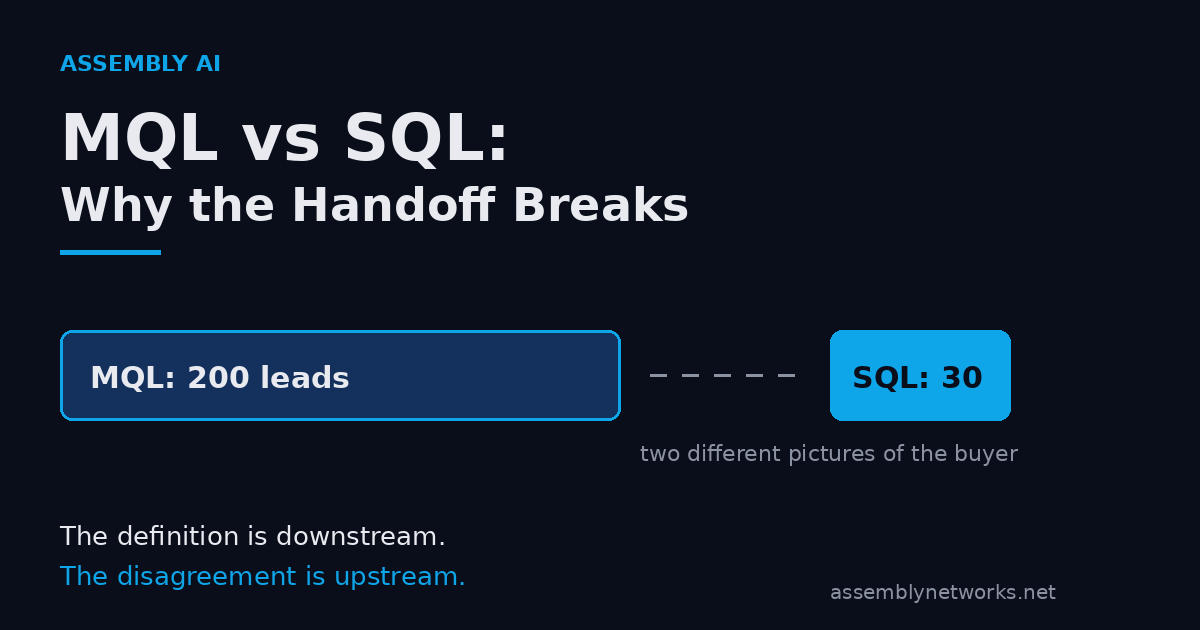
Every B2B company I have worked with has had some version of the same argument. Marketing hands over 200 leads. Sales accepts 30. Marketing says sales ignored the rest. Sales says the rest were never real. Then someone suggests tightening the definition, and everyone feels productive for about six weeks.
This post is about that argument, and about why the definitions are almost never the actual problem.
MQL vs SQL, in plain language
A marketing qualified lead (MQL) is a lead marketing judges ready to hand to sales, usually based on fit and engagement: the right kind of company, plus some behavior like a demo request or repeated visits. A sales qualified lead (SQL) is a lead sales has looked at and accepted as a real opportunity worth pursuing.
The handoff between the two is where the friction lives. That is not a coincidence. It is the one moment where two teams have to agree on what a good lead looks like, and it exposes whether they ever actually did.
Why the definitions keep failing
Most MQL criteria get built the same way. Marketing picks a few firmographics, assigns points to some clicks, and sets a threshold. Sales is told the number and asked to live with it. Nobody asks the harder question, which is whether the score predicts anything about who buys.
So the score rewards activity, not intent. A student downloads three ebooks and crosses the line. A real buyer reads one page, calls you, and never shows up in the score at all. Sales learns to distrust the number, marketing learns to defend it, and the gap between MQL and SQL volume becomes a permanent feature of the relationship.
I wrote earlier that alignment isn't a meeting problem. The MQL fight is the same thing in miniature. You can renegotiate the threshold forever and never fix it, because the two teams are working from different pictures of the buyer. A definition can only be as good as the understanding underneath it.
Fix the picture, then fix the score
Here is the order I would use, and it is mostly about doing things you probably skipped the first time.
- Start from closed-won, not from a guess. Pull your last 20 or 30 wins and look for what they share. Not just industry and size, but the trigger that started the search and who was in the room. That is the raw material for a real ideal customer profile.
- Name the problem, not just the persona. A lead who has the endemic problem you solve is worth more than one who matches a title. Fit criteria should include signals of that problem.
- Write down the anti-ICP. If sales keeps rejecting a certain kind of lead, say so out loud. An anti-ICP lets marketing stop sending them, and lets sales stop pretending they might close.
- Check the buying center. One contact is not a lead, it is a doorway. Note whether the buying center is visible yet.
Only after that does lead scoring make sense. Now the points have something true to measure against, and you can weight behavior by how much it actually preceded a win.
Make the handoff a conversation
Even a good definition needs a feedback loop. When sales rejects a lead, make them pick a reason from a short list that maps back to the profile: wrong fit, no problem, no authority, bad timing. Review the pattern monthly, together. If a third of rejections say "no problem," your scoring is rewarding the wrong behavior, and now you have evidence instead of opinions.
Add a service level that runs both directions. Marketing commits to a lead quality standard. Sales commits to a response time and to recording why they declined. It sounds bureaucratic, but it replaces a blame story with a shared dataset.
And do win-loss interviews. They are the quickest way to learn what really triggered the buyers you won, which is exactly what your scoring model is supposed to be guessing at.
The point of the definition
I have seen teams spend a quarter perfecting a scoring model that was built on the wrong buyer. It was very precise. It was precisely wrong. The goal is not an elegant MQL. The goal is that when marketing says "ready," sales agrees, because both of them are looking at the same buyer.
That shared picture is what the C3 Method is designed to produce, and it is what we are building into Assembly AI. If you want the short version of how this fits together, the FAQ is a good place to start.