Win-Loss Analysis: How to Find Out Why B2B Buyers Really Chose You (or Didn't)
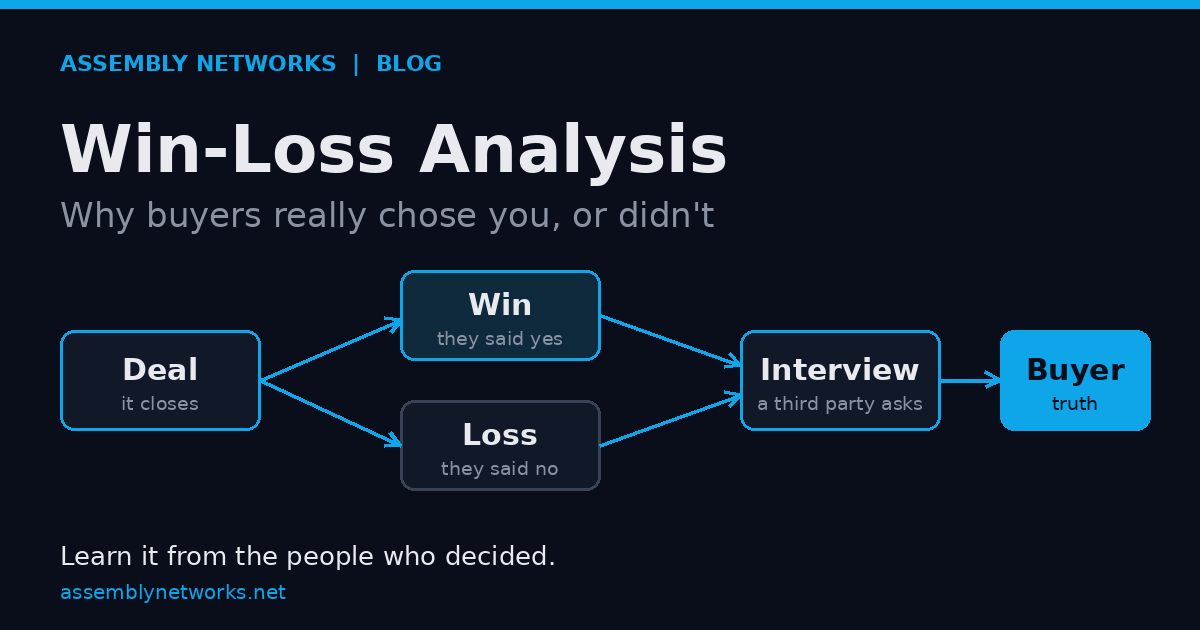
Ask a sales team why they lost a deal and you will hear a short list: price, timing, the buyer went with the incumbent. Ask why they won, and you will hear a longer one that flatters everybody in the room. Both lists are written from the seller's side of the table, which is the only side that is not making the decision.
Win-loss analysis fixes that by doing something almost embarrassingly simple. You ask the buyers. Not a survey with a five-point scale, but a real conversation with the people who chose you and the people who chose someone else, a few weeks after the decision, when it is still fresh and the stakes have gone quiet.
Why your own CRM can't tell you
Most CRMs have a "closed-lost reason" field. It is a dropdown. A rep picks one under deadline pressure, usually the one that sounds least like a rep's fault. "Price" is the most popular, because it is vague, it is blameless, and it ends the conversation.
The trouble is that price is almost never the whole story. It is often what a buyer says when the real reason (they were not convinced the problem was urgent, or nobody could explain why you were different) is more awkward to say out loud. If you take the dropdown at face value, you will spend the next quarter discounting a problem that was never about the number.
Interview the wins too
Teams that bother with this tend to do it only for losses, which is understandable and a little lopsided. Wins tell you which parts of your story actually landed, in the buyer's words, and that is the raw material for messaging that works.
Try to include a third group as well: deals that ended in no decision. They are the quiet majority in a lot of B2B pipelines, and the buyers in them will often tell you more than a clean loss would, because they have no reason to be polite about it.
Who should ask, and who should answer
Do not have the account executive make the call. The buyer will soften every answer to spare the rep, and the rep will quietly defend every decision. A third party, whether a colleague from another team or an outside interviewer, gets noticeably more candor.
On the buyer's side, aim for more than one person per deal if you can. Remember that a purchase is made by a buying center, not a person. The key decision maker will tell you what tipped the call, and the person who ran the evaluation will tell you what nearly sank you. You need both versions.
The questions that actually produce answers
Keep it to about 20 to 30 minutes and let the buyer do most of the talking. A short list I would start with:
- What was happening in the business when you first decided to look for something?
- Who else got involved, and what did each of them care about?
- Who else did you consider, and how did you decide who made the shortlist?
- What was the moment it became clear which way you were leaning?
- What almost changed your mind?
Notice that none of these are about your product. They map to the stages of the buyer decision journey, and that is the point. You are trying to reconstruct how the decision happened, not collect a review.
How many interviews are enough
Fewer than you would think. You are not after statistical significance, you are looking for patterns. Somewhere around 8 to 12 interviews, split across wins and losses, is usually enough for the same themes to start repeating. When you hear the same surprising thing for the third time, that is a finding, not an anecdote.
Turn the answers into decisions
The risk with this work is that it produces a lovely report that gets nodded at and filed. So decide in advance what the output feeds. In the C3 Method, it feeds buyer truth: the tested picture of what your buyers weigh. From there it sharpens your ideal customer profile (who actually wins and sticks), revises which endemic problems you lead with, and tells you where your positioning is failing to register.
Keep the raw quotes. A theme like "buyers did not see a difference" is easy to argue with. Three buyers independently saying "honestly, you all sounded the same" is much harder to wave off in a pipeline review.
Make it a habit, not a project
One round of interviews is useful. A steady trickle is better, because buyers and competitors change, and last year's reason for winning has a shelf life. A reasonable rhythm is a handful of interviews each quarter, tagged by segment, fed back into the same place your strategy lives.
That is the loop Assembly AI is built to keep intact, from what buyers said through to what your team says next. If you are weighing where to start, the FAQ covers how the pieces fit, and the alignment payoff shows up quickly: two teams argue less when they are both quoting the same buyer.