Sales and Marketing Alignment Isn't a Meeting Problem
Every company I've worked with has, at some point, decided that sales and marketing need to be more aligned. The remedy is almost always the same. A standing meeting. A shared dashboard. A service level agreement about lead follow-up. Somebody builds a spreadsheet, and for about six weeks it looks like progress.
Then the meeting gets moved, the dashboard stops getting opened, and the same two sentences come back. Marketing says sales isn't working the leads. Sales says the leads aren't worth working. Nothing has changed except that everyone now has less time on their calendar.
I've stopped believing that's a process failure. Meetings are not the missing ingredient. The two teams are aligned on the calendar and misaligned on the only thing that matters, which is what they each believe about the buyer.
Alignment theater
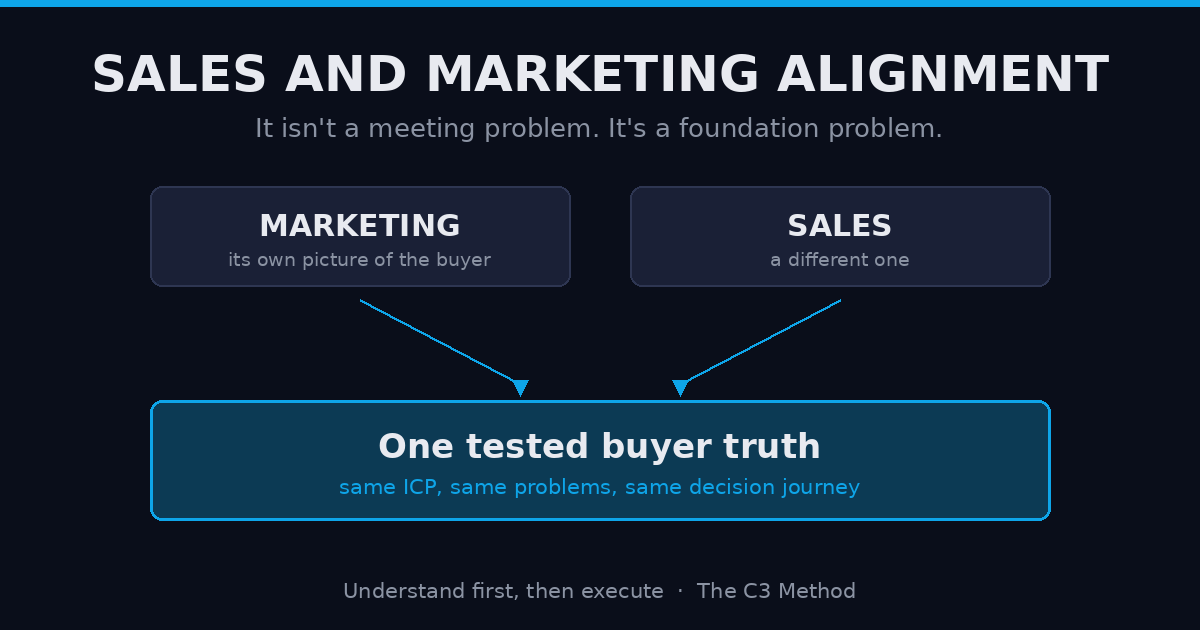
Here is what most alignment efforts actually do. They synchronize the outputs of two teams without ever reconciling the inputs. Marketing keeps its picture of the buyer. Sales keeps its own, assembled from whoever it happened to talk to last quarter. Then we hold a weekly meeting where these two different pictures politely fail to notice each other.
You can see the seam in the vocabulary. Marketing counts an MQL. Sales counts an SQL. Both teams can hit their number in the same quarter while the company misses its number, which should tell you something. When two teams can both succeed while the business fails, they are not measuring the same reality.
Redefining what counts as a qualified lead is the usual next move. It helps a little, in the way that agreeing on a thermometer helps when nobody has checked whether the patient is sick. The definition is downstream. The disagreement is upstream.
What's actually misaligned
Ask marketing to describe the ideal customer, then ask sales the same question in a separate room. In my experience you get two different answers, and neither team knows it. Marketing tends to describe a segment. Sales tends to describe the three accounts that closed easily last year. Both are drawn from real experience. Neither has been tested.
Now run the same exercise on why buyers buy. Marketing usually names a strategic problem, the one that sounds good in a campaign. Sales names the specific operational headache the buyer complained about on the call. Sometimes those are the same thing. Often they're not, and the gap explains why the content marketing produces never quite fits the conversation sales is having.
That's the misalignment. Not effort, not communication, not follow-up discipline. Two teams building on two different, unverified pictures of the same buyer, and then trying to coordinate the buildings.
Alignment is a shared foundation, not an agreement
The word alignment is part of the problem, because it implies negotiation. Get the teams in a room, split the difference, everyone concedes something, call it consensus. But a compromise between two guesses is still a guess. It's just one nobody feels ownership of.
What actually works is boring by comparison. You go find out. You do the buyer research once, properly, and both teams build on the result. Not marketing's version and sales' version reconciled, but one buyer truth that neither team invented and both teams can point to.
When that exists, alignment mostly stops being a project. Two teams working from the same foundation don't need a standing meeting to agree, any more than two people reading the same map need a weekly sync about which way is north.
What the shared foundation has to contain
Specifically, three things, and all three have to be researched rather than assumed.
The first is a real ideal customer profile, drawn from who you actually win and keep, not who you'd like to sell to. The second is the set of endemic problems that genuinely drive those buyers to look for a solution, in the buyer's language rather than yours. The third is the buyer decision journey, because a message that lands on someone who just recognized a problem is not the message that wins a head-to-head comparison, and both teams need to know which conversation they're in.
Get those three right and the arguments largely dissolve on their own. Lead quality debates get quieter because both teams are pointed at the same people. Messaging debates get shorter because there's a source to check instead of two opinions to defend. This is the entire premise of the C3 Method, and the reason we built Assembly AI around it rather than around another dashboard.
A quick test
If you want to know where you stand, try this. Separately, ask your head of marketing and your top salesperson to write down the top three reasons your best customers bought. Give them five minutes and don't let them confer.
If the lists match, you have a shared foundation and your alignment problem probably is operational, in which case the meetings might actually help. If the lists don't match, no amount of process is going to fix it, because your two teams are executing well against two different companies.
Most of the time, the lists don't match. That's not a failure of either team. It just means nobody ever went and checked. Our FAQ covers how we approach that research, and it takes less time than the year of meetings it replaces.