How to Define Your Ideal Customer Profile (Without Guessing)
Ask ten B2B companies for their ideal customer profile and you will get ten versions of the same sentence: mid-market, 200 to 2,000 employees, North America, technology or professional services, VP-level buyer. It reads like a filter in a prospecting tool, which is usually exactly where it came from.
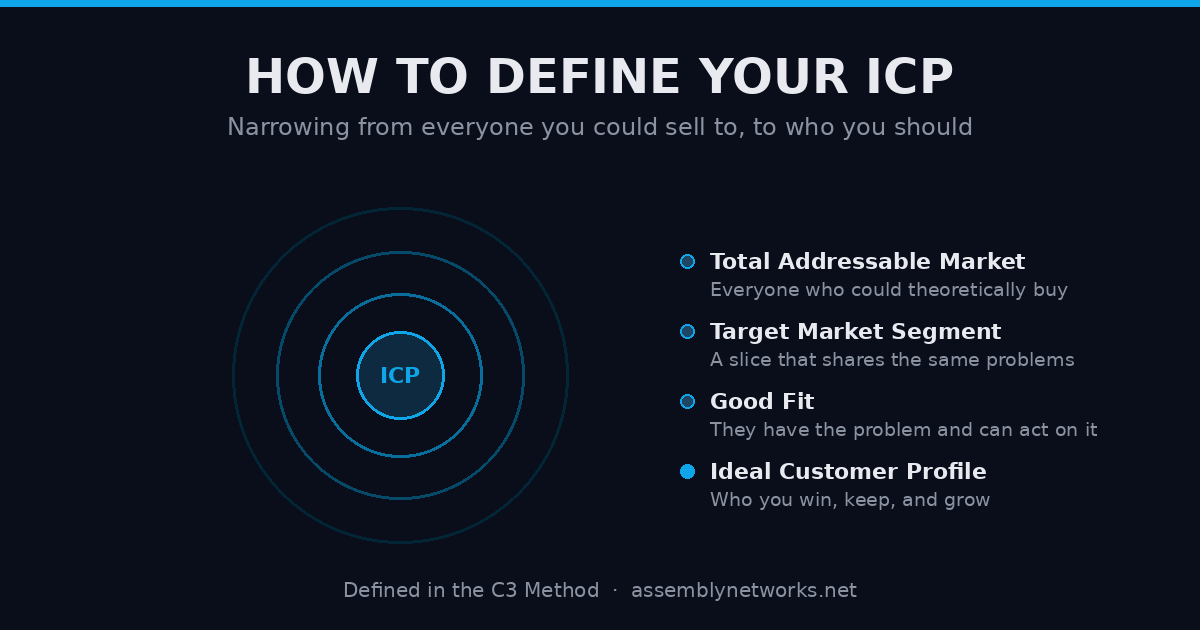
That is not an ICP. That is a list of companies you can find. An ideal customer profile is supposed to answer a harder question: out of everyone you could sell to, who are you actually built to win, keep, and grow? The firmographics are the easy part, and they are the part that tells you the least.
Why the conference-room ICP fails
The usual process is a whiteboard, a few opinions, and whoever has the strongest voice. Someone says "our sweet spot is really companies around 500 people," everyone nods, and it becomes doctrine. Nobody goes back and checks it against the deals that actually closed.
Then it quietly falls apart. Marketing builds campaigns for that profile. Sales gets the resulting leads and says they are not real buyers. Marketing points at the ICP everyone agreed to. Both teams are being reasonable, and both are working from a description nobody ever tested. This is the same crack that shows up in every other part of go-to-market, and it is why alignment keeps sliding off the meeting agenda and back into the pipeline.
Start with your own closed-won deals
The first place to look is not the market. It is your own history. Pull your last twenty or thirty wins and your last twenty or thirty losses, and put them side by side.
You are looking for the boring stuff nobody logs in the CRM. Which deals closed fastest, and why. Which ones renewed without a conversation. Which ones took nine months, three extra stakeholders, and a discount, then churned anyway. Which ones referred somebody. That pattern, not the industry code, is the beginning of your profile.
The uncomfortable finding is usually that your best customers cluster around something other than size. It might be that they had already tried to solve the problem internally and failed. It might be that a specific role, not a specific title, was the one who felt the pain. Those are the signals worth writing down.
Layer in the endemic problem
Here is the shift that makes an ICP useful: define it by the problem, not the profile. Two companies with identical firmographics can be completely different buyers if only one of them has the endemic problem you solve.
So the question becomes: what is true about a company that makes our problem real for them? Maybe it is a sales team that just doubled and cannot onboard fast enough. Maybe it is a product line that outgrew the story the founders were telling about it. Whatever it is, that condition is a better predictor than headcount, and it is the thing your CVP is written against.
Get the buying center right
An ICP that only describes a company is half an ICP. Deals are decided by people, and usually by several of them at once. You need to know who initiates, who influences, who controls the budget, and who is the key decision maker whose yes actually ends the conversation.
This is where most profiles get lazy and just name a title. Titles are wildly inconsistent across companies. What travels is the role in the buying center and the pressure that person is under. If you know that, you can find them in any org chart.
Write the anti-ICP too
The most useful page in an ICP document is often the anti-ICP, the one describing who you should not sell to. Every company has a category of deal that looks great in the pipeline review and terrible six months later, and everyone privately knows what it is.
Writing it down does two things. It gives sales permission to disqualify early, which is the cheapest thing a sales team can do. And it makes the positive profile sharper, because defining the edges of a thing is how you find out what it actually is.
Test it against real buyers
Everything up to this point is still an internal read of external reality. It is better than a whiteboard, but it is still your interpretation of why people bought.
The step most companies skip is going and asking. Talk to customers about what they were actually trying to fix, what else they considered, and who else was in the room. Talk to a few people who chose someone else. You will find at least one assumption in your profile that does not survive contact with the buyer, and finding it is the entire point.
That is the work the C3 Method is built around: moving from what you assume about your buyer to what you can demonstrate, then letting positioning, messaging, and targeting fall out of the evidence rather than the argument. An ICP grounded in buyer truth is one that sales and marketing will both use, because neither team has to take the other's word for it.
Keep it alive
An ICP is not a document you finish. Markets shift, your product changes, and the profile that was right two years ago quietly stops being right. Revisit it when your win rate moves, when a new segment starts showing up unprompted, or at least once a year on purpose.
At Assembly AI, we turn buyer research into a profile you can act on, then score real prospects against it so your team is not relitigating who counts as a good fit every Monday. If you have more questions about how this fits together, the FAQ covers the usual ones.