B2B Buyer Research: How to Find Out What Your Buyers Actually Think
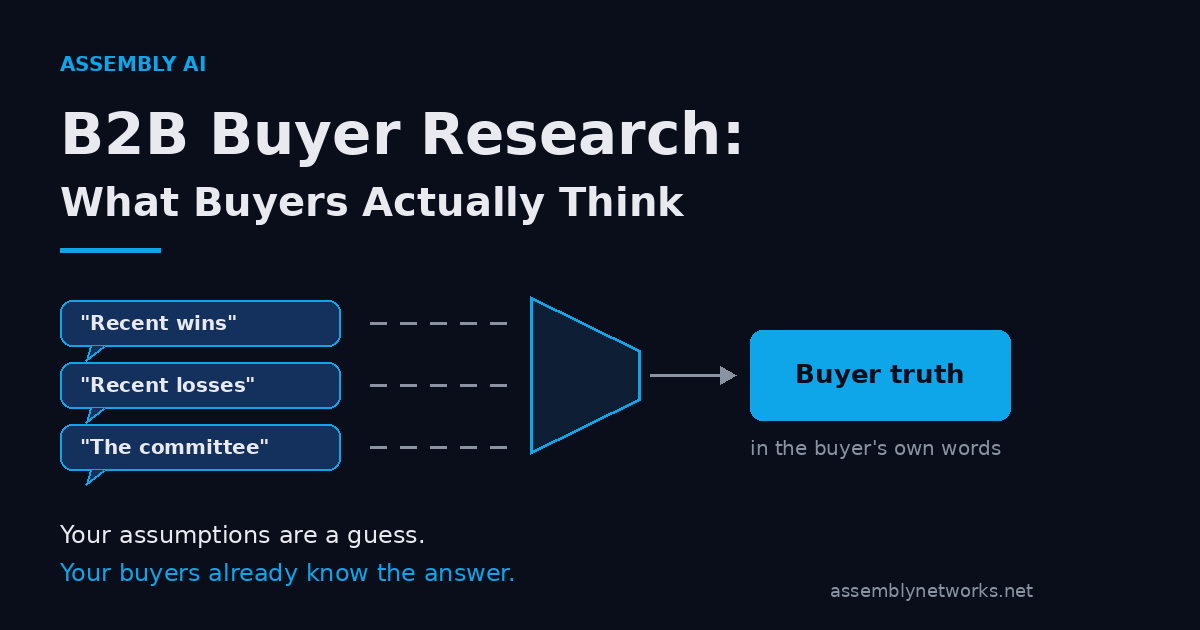
Ask a room full of B2B leaders whether they understand their buyer and every hand goes up. Ask when they last talked to one, outside of a sales call, and the hands get a lot more thoughtful.
That gap is where most go-to-market trouble starts. We build positioning, messaging, and campaigns on what we believe buyers think. Then we act surprised when buyers don't think it. B2B buyer research is the unglamorous fix: go find out, on purpose, before you spend the budget.
I want to make the case that it is simpler than most teams assume, and that skipping it is far more expensive than doing it.
What buyer research is (and what it isn't)
Buyer research is the deliberate practice of learning how your buyers recognize a problem, who gets involved in solving it, and what actually tips the decision. The goal is buyer truth: what buyers really think and weigh, learned from them rather than inferred by you. Some teams call this voice of the customer work, which is fine, as long as the customer is actually doing the talking.
It isn't your CRM notes. It isn't the reasons your reps give for lost deals (those are reasonable guesses from people with an obvious stake in the answer). And it isn't a persona deck someone built from a stock photo and a hunch. All of those have their place, but they are opinions about the buyer. Research is the buyer's own account.
Who to talk to
The most common mistake is only talking to happy customers. They are easy to reach and pleasant to interview, which is exactly why they teach you the least. A useful research mix looks more like this:
- Recent wins. Buyers who chose you in the last few months, while the decision is still fresh.
- Recent losses. Buyers who chose a competitor, or chose to do nothing. This is the group most teams avoid and the one with the most to teach. (A structured win-loss analysis is a great way to make this routine.)
- The whole committee. Not just your champion. The finance lead, the end user, and the person who could have quietly killed the deal all see it differently. Your buying center is the real audience, so research it like one.
- People who fit your ICP but have never heard of you. They tell you how the problem looks before your marketing gets to frame it.
You don't need hundreds of conversations. In my experience the patterns start repeating somewhere around the eighth or tenth interview in a segment. When you can predict the next answer, you have learned what that segment can teach you.
What to ask
Good buyer research questions are about the buyer's world, not your product. If the conversation turns into a feature review, you've stopped researching and started demoing. A few questions I keep coming back to:
- What was happening in your business that made this a priority now, rather than last year?
- What did you try before looking for an outside solution?
- Who else had to agree, and what did each of them care about?
- What almost stopped the decision?
- How would you describe the problem to a peer at another company?
That last one is my favorite. The words a buyer uses with a peer are the words your messaging should use. They are almost never the words in your current homepage headline, which is humbling and also very useful.
Listen especially for the endemic problem, the persistent, built-in issue that keeps showing up across buyers in a segment. That is the problem worth building your story around.
Interviews, surveys, or both?
Interviews give you depth. You hear the hesitation, the side comment, the thing they mention twice. Surveys give you breadth and let you check whether what you heard in ten interviews holds across a hundred buyers.
The sequence matters. Interview first to discover what questions are worth asking, then survey to measure how widely the answers apply. Teams that start with a survey usually end up measuring their own assumptions with great precision. The numbers look rigorous, but they only confirm the options you thought to list.
Turning answers into something sales can use
Research that lives in a slide deck changes nothing. The point is to feed it directly into the decisions that matter: who you target, how you position, and what your reps say on the first call.
That means translating what you heard into a short set of tested statements. The problem buyers describe, in their words. The criteria they actually used to decide. The objections that almost stopped them. From there, your messaging and key selling points stop being a marketing exercise and become something both teams recognize as true. That shared recognition is most of what sales and marketing alignment really is.
This is the first step of the C3 Method, and it is why we built buyer research directly into Assembly AI. Understanding comes before execution, and understanding comes from asking.
Where to start this week
Pick five buyers: two recent wins, two recent losses, and one ideal-fit company that has never bought from you. Ask for 30 minutes and promise you won't sell. Then keep that promise, which is harder than it sounds.
Write down the exact phrases they use. Compare them to your website and your sales deck. If the language doesn't match, you've found your first fix, and it didn't cost you a campaign to learn it.
If you'd like help designing the research or making sense of what comes back, the FAQ covers how we work, or we can simply talk it through.