How to Write a B2B Positioning Statement (That Buyers Can Actually Feel)
Most positioning statements read like a Mad Lib that someone completed under mild duress. "For innovative mid-market companies, our best-in-class platform delivers transformative results." You could swap in any company's name and the sentence would still be equally true, which is another way of saying it tells a buyer nothing.
Positioning is simply how you want to be understood in the buyer's mind, relative to the alternatives. A positioning statement is the short internal sentence that pins that decision down, so everyone writing, selling, and building is aiming at the same spot. It is not a tagline. Buyers will probably never see it, and that is fine.
What a positioning statement is (and isn't)
Think of it as the keel under the boat. You do not look at it, but it keeps everything else from tipping over. Your website, your sales deck, and your cold emails all steer by it.
It is also not messaging. The statement is the decision. Messaging is that decision made speakable for a specific audience at a specific moment. If you start writing the messaging before the decision exists, every writer invents their own version, and you get a company that sounds slightly different on every page.
Start with the buyer, not the feature list
The usual way to write one is to open a template and fill in the blanks from memory. The better way is to fill the blanks from evidence. Before you write a word, you want three things on the table.
- Who you are for, based on who actually wins and stays (your ideal customer profile).
- The endemic problem that drives them to look for help at all.
- What they do today instead, which is your real competition. Often it is a spreadsheet, a habit, or doing nothing.
That is buyer truth, and it is what the C3 Method asks you to establish first. If you cannot fill those three in with something a buyer has actually said, you are not ready to position. You are ready to go and ask.
A simple structure that holds up
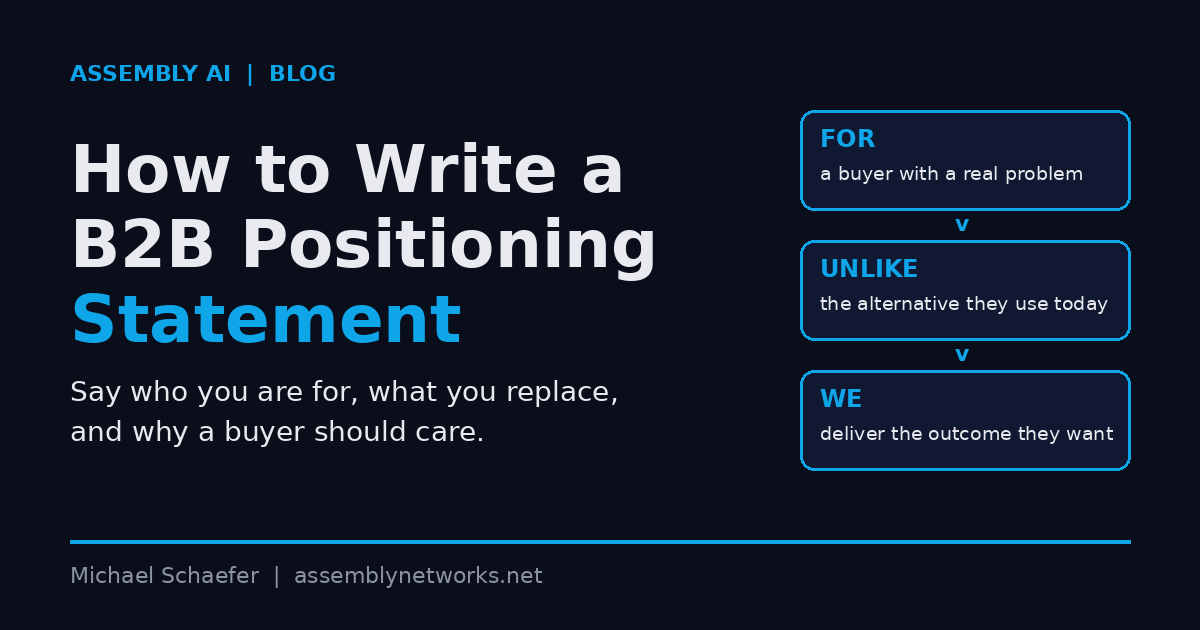
The classic format still works because it forces the right questions. Roughly: for [a specific buyer] who [has this problem], [your offering] is a [category] that [delivers this outcome]. Unlike [the alternative they use today], we [do this differently].
Each blank is a decision, and each one can go wrong in a predictable way:
- The buyer is too broad. "Growing companies" is everyone, so it is no one. Pick the segment that wins most often.
- The problem is a feature in disguise. "Needs better dashboards" is a feature request. "Cannot tell which half of the pipeline is real" is a problem.
- The alternative is a competitor logo. Often the honest alternative is inertia. Name the thing buyers actually compare you to.
- The difference is not noticeable. A competitive differentiator only counts if a buyer would notice it and care.
Run the "swap test" before you celebrate
Here is a quick check I like. Paste a competitor's name over yours. If the statement still holds, it is not positioning, it is a category description. Then try the reverse: could a buyer disagree with it? A good statement takes a position, which means somebody could reasonably say "that's not for me." That is a feature. Being the right answer for a few people beats being a vaguely acceptable answer for everyone.
Test it against real buyers
Your statement is a hypothesis until a buyer reacts to it. Read it to five or six people who fit your ICP, including a couple who chose someone else, and watch what happens. Do they nod, or do they ask what you mean? Do they restate it in their own words? The words they use are gold, because they are the language your messaging should borrow.
The interviews you run for win-loss analysis are a ready-made place to do this, since the buyers are already telling you how they weigh the decision. Their answers often reveal that you have been positioning against the wrong alternative.
Get it out of the doc and into the call
A positioning statement that lives in a slide is a souvenir. For it to matter, sales has to be able to say the gist of it in plain language, and marketing has to be writing the same thing. This is where it connects to sales and marketing alignment: two teams that share one positioning argue less, because they are describing the same buyer and the same difference.
From the statement, build downward. One customer value proposition per endemic problem, then key selling points backed by proof points, then a message map by audience and stage. If you want the long version of that last part, the messaging framework post walks through it.
Revisit it on a schedule
Markets move, competitors copy you, and the problem buyers care about this year may not be next year's. Put a review on the calendar, once or twice a year, and ask whether the statement still matches what buyers are telling you. This is the kind of loop Assembly AI is designed to keep honest, and the FAQ covers how it fits together if you are curious.
If your current positioning could survive a competitor's name swap, that is the first thing to fix. It is also a very good conversation to have with someone who has seen a lot of them.