How to Build a B2B Messaging Framework Sales Will Actually Use
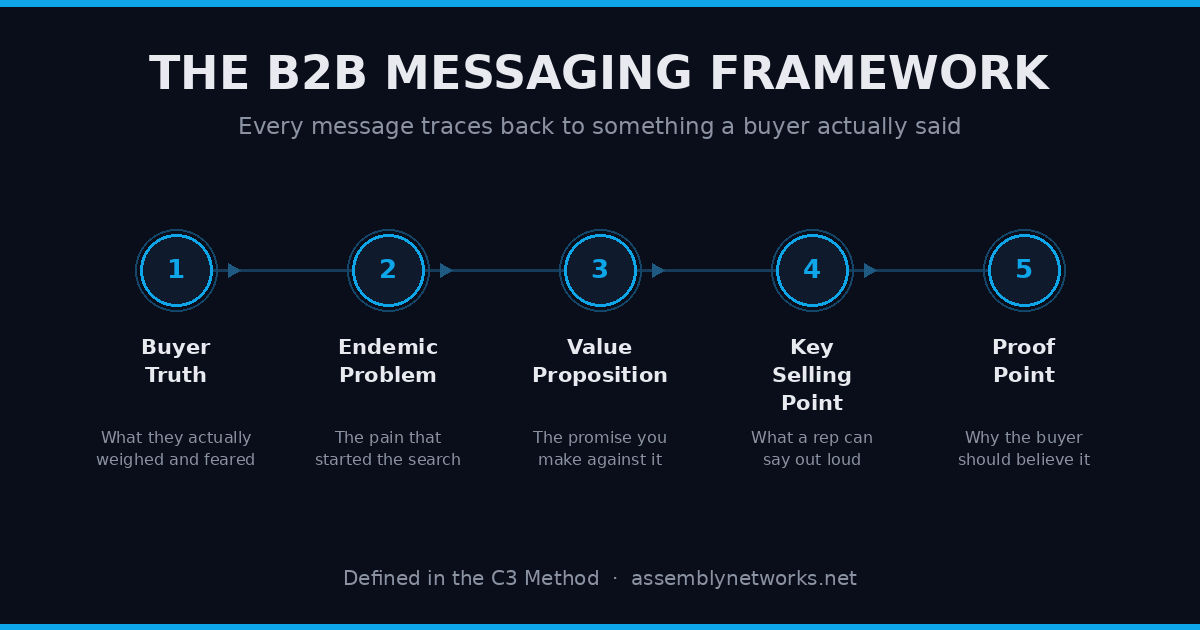
Almost every B2B company I talk to has a messaging framework. It is usually a deck, it usually has a pyramid on slide three, and it usually got one round of applause at the offsite and has not been opened since. Meanwhile the sales team is out there saying whatever worked on the last call, which is its own kind of framework, just an undocumented one.
I do not think that happens because salespeople are difficult. It happens because most frameworks are written for the wrong reader. They are written to make the marketing team feel like the story is settled. A messaging framework earns its keep only when a salesperson can say a line out loud on a Tuesday afternoon and watch a buyer nod.
The framework dies when it starts with the product
The standard build goes like this. Someone pulls the roadmap, lists the capabilities, groups them into three pillars, and writes a benefit statement over each one. It is tidy. It is also a description of what you made, arranged in the order you made it.
Buyers do not experience your product as pillars. They experience a problem that got annoying enough to do something about. If your message opens where your product opens, you are asking the buyer to translate, and translation is work they will not do for a vendor they have not met yet.
Start with buyer truth, not the offsite
The first input to a messaging framework is not your product. It is buyer truth: what your buyers actually weighed, feared, and argued about internally before they signed. You get that by asking them, including the ones who picked somebody else, which is the less fun half of the exercise and the half that changes the most.
What you are listening for is the language, not just the content. Buyers rarely describe your category the way you describe it. When three separate people use the same slightly wrong phrase for the problem, that phrase is worth more than anything written in a conference room, because it is already in their heads.
One message per problem, not one message for everything
Here is the structural move that makes a framework usable. Instead of a single grand narrative, you build one line of messaging per endemic problem you solve.
Each problem gets a compelling value proposition, which is a promise: if you do this, it fixes that problem and reduces its effect. Each value proposition gets a key selling point, which is the version a human can say without reading it. And each selling point gets proof. That chain (problem, promise, selling point, proof) is the whole framework. Repeat it per problem and per segment and you are done.
The advantage is that sales does not have to remember a story. They have to recognize a problem, and then the right message is already attached to it. That is a much smaller ask.
Attach a proof point or it is just a claim
Every message should have a proof point stapled to it: a number, a named customer outcome, a demonstrable mechanism, something. If the only support for a claim is that you believe it strongly, a buyer has no way to tell you apart from the three other vendors making the same claim in the same font.
This is also a useful filter on your own differentiators. Write the claim, then try to find the proof. The claims that survive that exercise are the real ones. The ones that do not are usually the ones sales was already quietly dropping.
Write it in sales language
Say the lines out loud before they go in the document. If a sentence has three clauses and the word "leverage," nobody is ever going to say it to another person. Marketing tends to write for the eye, and the eye is patient. Sales messaging has to work in the ear, where it gets about six seconds.
The practical test I use: hand a line to a rep who has been there under a month. If they can deliver it convincingly without prep, it is good. If they pause to figure out what it means, it is a positioning statement, not a message, and it belongs in the appendix.
Map messages to the stage, not just the audience
Most frameworks segment by persona and stop there. But the same CFO needs completely different things depending on where she is in the buyer decision journey. Early on, the job of the message is to make a problem feel worth solving. Late in the process, the job is to make choosing you feel defensible to her peers.
A good message map covers both axes, who is listening and what they are trying to do right now. It is more work up front, and it is the difference between content that generates interest and content that closes the gap at the end.
Put it where the work happens
A framework in a shared drive is a framework nobody uses. The versions that stick get pulled into the things sales already touches: call prep, the first-meeting deck, the follow-up email templates, onboarding for new reps. If using the messaging is harder than improvising, people will improvise.
Then revisit it. Messaging is a hypothesis about what moves buyers, and hypotheses go stale. When win rates shift or a competitor changes their story, go back to the buyer conversations rather than the pyramid.
This is the part of the C3 Method that does the most visible work, and it is why alignment tends to follow rather than lead. Two teams stop arguing about the story when the story is traceable to something a buyer actually said. Assembly AI keeps that chain intact, from the research through to the message a rep has in front of them on the call. If you want the short version of how the pieces connect, the FAQ covers it.