The B2B Buying Committee: How to Sell When Six People Have to Say Yes
Early in my career I lost a deal I was sure I had won. The contact loved us. He said so on three separate calls, used the word "partner," and told me the paperwork was a formality. Then the deal went quiet, and a month later I learned we'd been dropped by someone I had never met.
That someone controlled the budget, had a different problem than my contact did, and had never heard a word from us. I had sold to one person. The company had bought as a group.
What a B2B buying committee actually is
A B2B buying committee is the set of people who shape, approve, or can block a purchase. Nobody schedules it, and there's rarely an official roster. It forms around the decision, does its work in meetings you aren't invited to, and dissolves when the contract is signed.
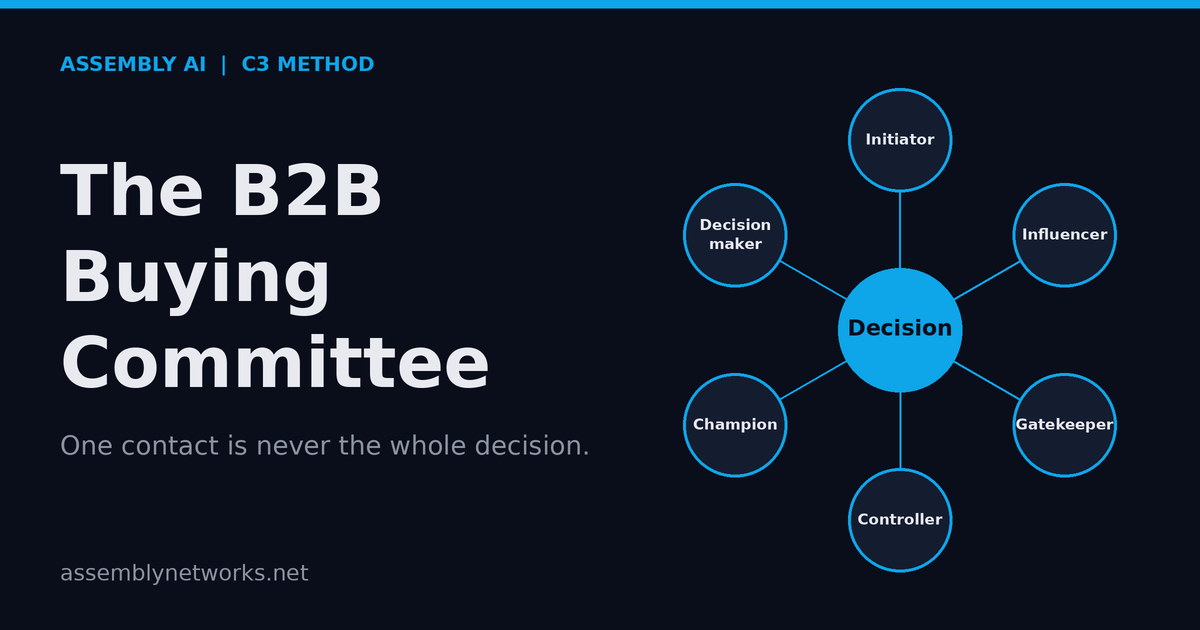
On the buying center model, the roles look like this:
- Initiator. The person who first notices the problem and starts the search.
- Influencer. Someone whose opinion carries weight, often a practitioner who will live with the choice.
- Gatekeeper. The one who controls access to information and to other people.
- Controller. The one who holds the budget or the process, and can say "not this quarter."
- Decision maker. The key decision maker, whose yes is the one that counts.
One person can wear several of these hats, and in a small company one person often wears all of them. In a bigger one, you may have a different person for every role, each with their own worry.
Why one great contact is never enough
Here is the trap. The person who talks to you the most is usually the initiator or an influencer, because they have the problem and the motivation to take your calls. They're also the person with the least power to close.
Meanwhile the controller is asking whether this is worth the money. The gatekeeper is asking whether it's one more thing to manage. The decision maker is asking whether it's safe. None of them are asking your champion's question, which is "does this solve my problem?"
If your message only answers the first question, you've won the room that doesn't decide. And if it's the same message for everyone, it will be a little wrong for each of them.
Each role has its own endemic problem
This is where the C3 Method earns its keep. Every member of the committee has an endemic problem of their own, the pain that makes this purchase matter to them personally.
The practitioner's problem might be wasted hours. The finance lead's might be a cost that keeps climbing without a clear return. The executive's might be a missed number they have to explain next quarter. Same purchase, three different reasons to care, and three different things they need to hear.
That is why messaging built for "the buyer" tends to land softly. There isn't one buyer. There is a group, and a message map that covers each role at each stage of the buyer decision journey does far more work than a single polished pitch.
Find the champion, then arm them
You can't attend the internal meetings, so someone else has to carry your case into them. That person is a champion, an insider who wants you to win and will speak up when you aren't there.
A champion with nothing to say is just a friendly contact. The useful ones have language they can repeat: a clear statement of the problem, a plain account of why your approach is different, and a proof point their skeptical finance colleague will accept. If you've done your proof point homework, handing it over takes five minutes. If you haven't, your champion improvises, and improvised pitches drift.
Three questions to ask on every deal
You don't need a new tool for this. You need the habit of asking, early and again whenever a deal stalls.
- Who else will have a say in this, and what do they care about?
- Who controls the budget, and have they heard from us directly?
- If our contact were out sick for a week, who would carry this forward?
The third one is uncomfortable, and that's the point. If the answer is "nobody," you have a single point of failure dressed up as a relationship.
What this changes for sales and marketing
For marketing, it means content for the whole committee, not only for the person who fills out the form. For sales, it means mapping the roles before the proposal goes out, not after it goes quiet. And for both, it means working from the same picture of who decides, which is the heart of real sales and marketing alignment. (I wrote more about why that isn't a meeting problem in this earlier post.)
If you want the short version of how Assembly AI approaches this, the product page walks through it, and the FAQ covers the common questions. Otherwise, the next time a deal goes quiet, ask who else was in the room. It's usually someone you haven't met.