Why Most Go-to-Market Strategies Fail (and It Isn't Execution)
I've watched a lot of go-to-market plans stall over the years, including some of my own. And the strange part is how similar the autopsy always sounds.
The campaign underperformed. The messaging didn't land. The leads were low quality. Sales said marketing sent junk, marketing said sales didn't follow up, and everyone agreed the answer was to do more. More content, more channels, more tactics. So we did more. And most of the time, more didn't fix it.
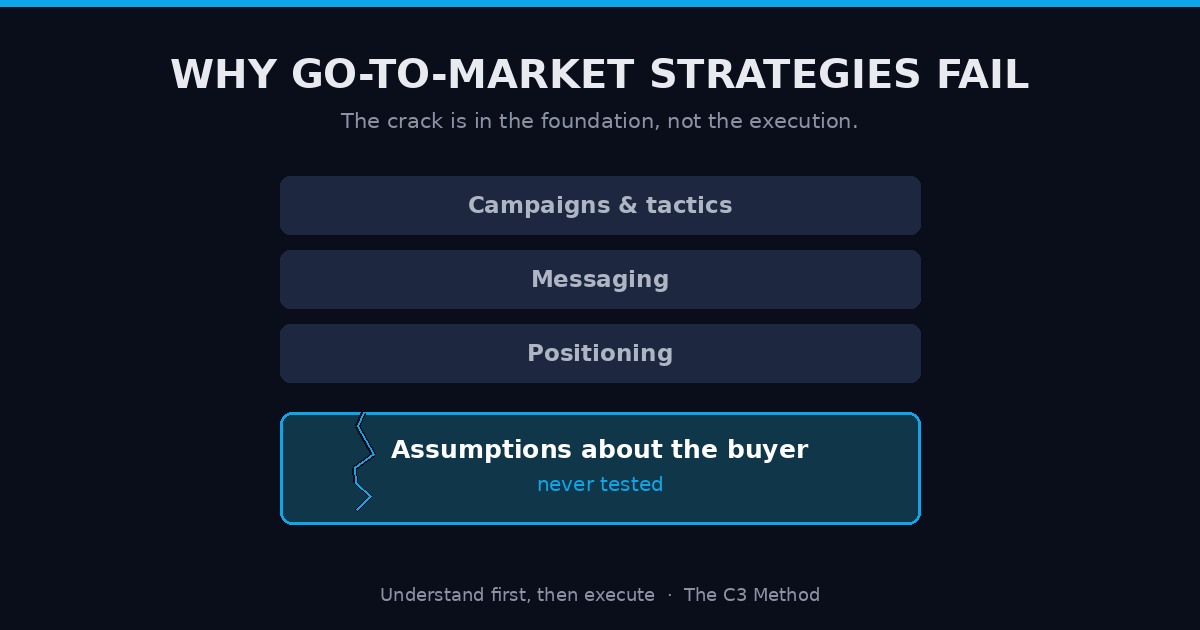
After 25+ years, I've come to believe we usually misdiagnose the failure. We treat it as an execution problem because execution is the part we can see. But the real crack is almost always further upstream, in something we never actually checked.
The comfortable diagnosis
Blaming execution is comfortable, because execution is fixable with effort. Rewrite the email. Retarget the audience. Add a nurture track. It feels productive, and it keeps the strategy itself above suspicion.
That's the tell. When a plan is struggling and every proposed fix is a tactic, it usually means nobody wants to reopen the assumptions the plan was built on. Which is understandable. Reopening them is slower, less flattering, and occasionally a little humbling.
The real failure: assumptions nobody tested
Here is the pattern I see most. A company defines its buyer early, often in a single afternoon, based on the experience in the room. That definition then quietly becomes the foundation for everything: the positioning, the messaging, the targeting, the campaigns.
And nobody goes back to check whether it was ever right.
So the whole go-to-market gets built on a guess about the buyer. When results come in soft, the instinct is to adjust the visible layers, the tactics, while the untested foundation sits underneath the entire time. You can run flawless campaigns on a wrong understanding of the buyer and still lose. In fact you'll lose faster, because you'll scale the mistake.
The uncomfortable truth is that most go-to-market strategies don't fail at execution. They fail at understanding, long before a single campaign ships.
What "understanding the buyer" actually means
"Understand your buyer" is one of those phrases that sounds obvious and gets skipped anyway, partly because it's vague. So let me be specific about what it means in practice.
It means knowing the endemic problem that actually drives someone to look for a solution, not the feature you wish they cared about. It means knowing who is really in the buying center and which of them holds the final yes. And it means knowing where a buyer is in their decision journey, because the message that moves someone who just recognized a problem is not the message that moves someone comparing you to two competitors.
Get those wrong and no amount of execution saves you. Get them right and mediocre execution still works, because you are at least aiming at the truth.
A different order of operations
The fix isn't complicated to describe, though it does require resisting the urge to jump straight to doing.
Understand first, then execute. Test the assumptions about the buyer before you build the plan on top of them. Define who you actually win with, learn the problems that genuinely move them, map how they decide, and only then write the messaging and pick the tactics. When execution rests on tested understanding, the tactics finally have something solid to stand on.
This is the whole idea behind the C3 Method, the framework I've spent my career refining and the foundation of what we're building at Assembly AI. It exists because I got tired of watching good teams do more and more on top of a foundation nobody had checked.
Where this leaves you
If your go-to-market isn't working, it's worth asking an honest question before you approve the next round of tactics: are we sure we understand how our buyers actually decide, or have we just been assuming it this whole time?
Sometimes the answer is yes, and the problem really is execution. But often enough, the more valuable move is to stop adding and start checking. It's slower. It's less immediately satisfying. And in my experience, it's the difference between doing more and doing better.
If that question lands, that's exactly the gap Assembly AI is built to close.