How to Build a Go-to-Market Strategy (a Step-by-Step Approach)
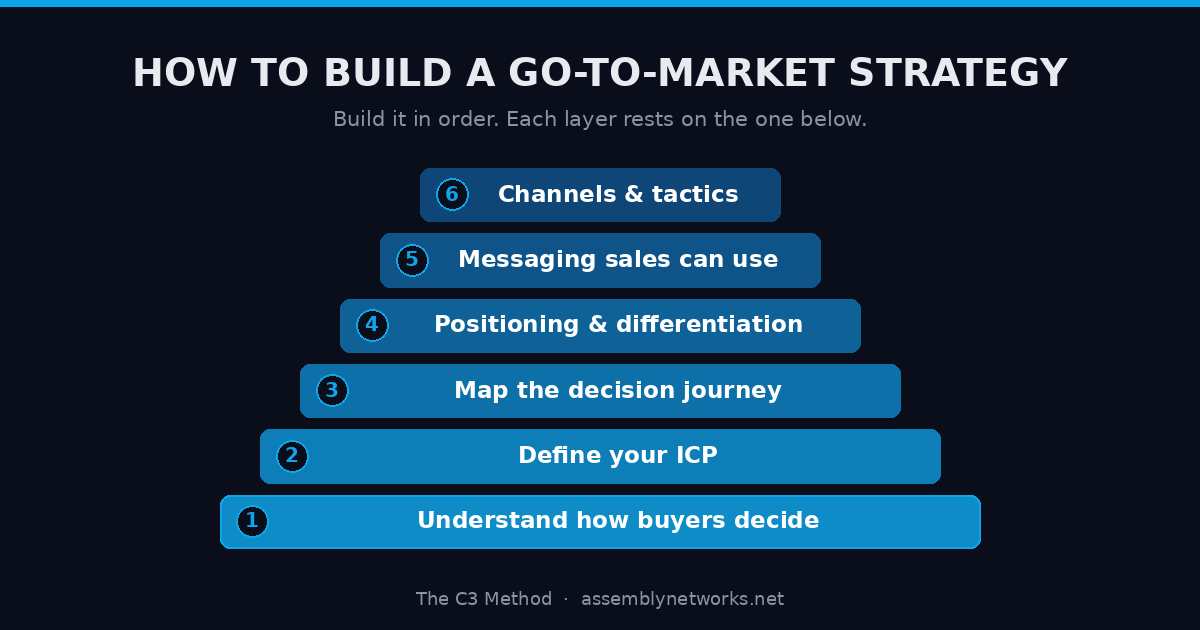
Search "how to build a go-to-market strategy" and you'll get a hundred templates, most of them a tidy list of boxes to fill: positioning, pricing, channels, a launch calendar. They aren't wrong, exactly. But they tend to start in the middle, with what you want to say and do, and quietly skip the part that determines whether any of it works: whether you actually understand the buyer you're building it all for.
So this is a step-by-step guide, but the order is the point. Build these in sequence and the later steps have something solid to stand on. Skip to the fun parts and you're decorating a foundation nobody checked.
What a go-to-market strategy actually is
A go-to-market strategy is the plan for how you bring a product or service to market: who you sell to, what you say to them, how you reach them, and why they choose you over the alternatives. That's it. Everything else, the campaigns, the sales plays, the pricing tiers, is downstream of those four answers.
The reason most strategies wobble is that the four answers get assumed rather than learned. Let's take them in the order that keeps you honest.
Step 1: Understand how your buyers actually decide
Start here, before anything else. Not with your product, not with a competitor teardown, but with the buyer's reality. What is the endemic problem that pushes them to go looking in the first place? Who is actually in the room when the decision gets made? What do they weigh, worry about, and compare?
The honest way to learn this is to ask them, through real buyer research rather than a whiteboard session. It's the least glamorous step and the one teams most want to skip, which is precisely why it's where the advantage lives. Get this right and the rest of the strategy almost writes itself. Get it wrong and you'll scale a misunderstanding.
Step 2: Define your ideal customer profile
Once you understand the buyer, you can define who you're actually best for. Your ideal customer profile (ICP) is a clear description of the companies and people you're positioned to win and keep, covering the firmographics and the deeper fit signals that predict success.
Most companies serve more than one target market segment, and each deserves its own understanding, because a segment's problems and buying behavior are what make it a segment in the first place. Resist the urge to write an ICP so broad it describes everyone. A profile that fits everyone guides no one.
Step 3: Map the decision journey
Buyers don't decide in a single moment. They move through a buyer decision journey, and the message that moves someone who has just recognized a problem is not the message that moves someone comparing you against two finalists.
In the C3 Method we map that journey across seven stages: Need, Motivation, Search, Evaluation, Select Set, Decision, and Confirmation. You don't need to memorize the labels to take the point, which is simply this: know where a buyer is, and you know what they need to hear next. Strategy that ignores the journey ends up shouting the same thing at everyone and wondering why it only lands sometimes.
Step 4: Nail positioning and differentiation
Now, and only now, you decide how you want to be understood. Positioning is the place you claim in the buyer's mind relative to the alternatives, and it's a genuine decision, not a tagline you reverse into later.
Positioning is only real if a buyer would notice the difference. A competitive differentiator that only your product team can detect is not a differentiator, it's a footnote. Anchor it to the endemic problems you found in Step 1, and it will hold.
Step 5: Build messaging a salesperson can actually use
Messaging is positioning made speakable: the specific language that carries your value to a given audience at a given stage. The test is brutally practical. Could a rep say this out loud to a real buyer without wincing? If not, it's copy, not messaging.
This is also where sales and marketing alignment stops being a slogan. When both teams work from the same buyer truth, the same ICP, and the same decision map, they stop blaming each other and start compounding. Misalignment is almost never a personality problem. It's usually two teams working from two different guesses about the buyer.
Step 6: Choose channels and tactics last
Notice how far down the list this is. Channels, campaigns, and the launch calendar are the visible, satisfying part, which is exactly why teams start here. But a channel is just a way to deliver a message to a buyer. If the message and the buyer are right, mediocre channel execution still works. If they're wrong, flawless execution just spreads the mistake faster.
Pick the channels where your ICP actually spends attention, match the message to their stage in the journey, and give yourself a way to learn what's working. Then, and this is the whole discipline, be willing to go back to Step 1 when the market tells you something you didn't expect.
A quick gut check
If you already have a go-to-market strategy and it isn't landing, you don't have to rebuild it from scratch. Run it back through these steps and find the earliest one you can't answer with evidence instead of assumption. That's almost always where the strategy is quietly leaking. Fix it there, and the downstream steps get easier on their own.
The short version
Understand the buyer, define who you win with, map how they decide, then position, message, and execute on top of that foundation. It's not a complicated sequence. It's just a disciplined one, and the discipline is resisting the urge to jump straight to the doing.
That discipline is the whole idea behind the C3 Method, and it's what we operationalize at Assembly AI: turning real buyer research into a validated ICP, a decision map, and messaging your team can use, in weeks rather than months.