The 7 Stages of the B2B Buyer Decision Journey
Here's a quiet truth about B2B marketing: most of it is aimed at a buyer who is ready to buy. Which is a problem, because on any given day, almost none of your market is. The rest are somewhere earlier in a longer journey, and they need something different from you than a demo request.
A buyer decision journey is the sequence of stages a buyer moves through before they choose. Map it, and a lot of go-to-market confusion clears up, because you stop asking "what should our message be?" and start asking the better question: "what does a buyer at this stage need to hear next?"
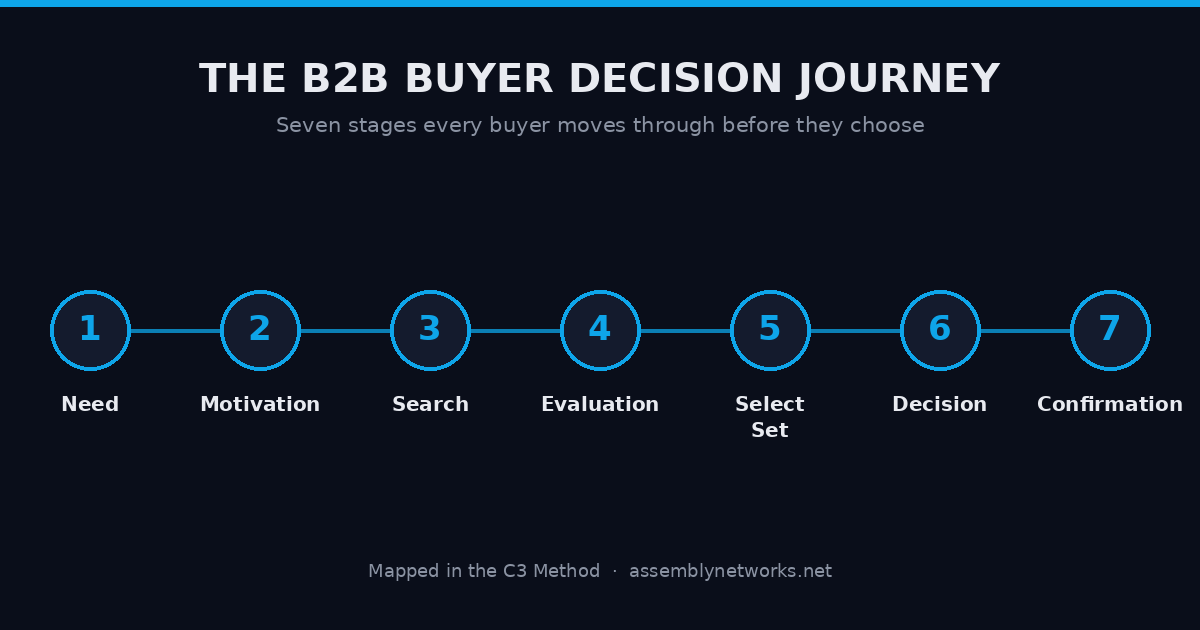
In the C3 Method, we work with seven stages. Here's what happens at each, and what your job is when a buyer is standing in it.
1. Need
Before anything else, there's a gap between where the buyer is and where they want to be, whether or not they've put words to it. At this stage they may not even be looking. The endemic problem exists, but it hasn't yet become urgent.
Your job here isn't to sell. It's to help them name the problem clearly. Content that articulates a pain better than the buyer could themselves is what earns you the right to be in the conversation later.
2. Motivation
Something turns a background annoyance into a priority: a missed number, a new competitor, a leadership change, a budget that suddenly exists. This is the moment a latent need becomes an active one.
You can't manufacture motivation, but you can be the voice that connects the trigger to the cost of inaction. Buyers move when staying put starts to feel more expensive than changing.
3. Search
Now they go looking, and notably, they look for approaches before they look for vendors. They're building a mental map of what solutions even exist. This is where being genuinely findable and genuinely helpful pays off, long before anyone fills out a form.
Your job is to be present with real substance when a buyer is educating themselves. Gate everything behind a demo request at this stage and you simply won't be in their research.
4. Evaluation
The buyer starts comparing options against what matters to them. This is where your positioning earns its keep, because they're now weighing you against alternatives, and a difference they can't perceive doesn't count.
Give them the criteria to evaluate well, and be honest about where you fit and where you don't. Buyers trust a source that helps them decide over one that only helps itself.
5. Select Set
Out of everything they considered, the buyer narrows to a shortlist, the two or three they'll seriously pursue. Making this cut is a real threshold. If you're not in the select set, the rest of the journey happens without you.
What gets you here is clarity and fit: a buyer can articulate, in a sentence, why you belong on the list. If your value takes a paragraph to explain, you're a maybe, and maybes get cut.
6. Decision
Now the real buying center shows up, the several people whose input shapes the choice and the one key decision maker whose yes actually settles it. Deals stall here not because the buyer went cold, but because an internal stakeholder had a concern nobody addressed.
Your job is to arm your champion for the conversations you're not in the room for. The best selling at this stage happens between your meetings, in the buyer's own hallways.
7. Confirmation
The decision isn't the end. After choosing, the buyer looks for evidence they chose well, and that reassurance shapes whether they expand, renew, and refer, or quietly regret it. The journey loops back into the next one.
Deliver early proof of value and make them feel smart for picking you. Confirmation is where satisfied customers become the reason your next buyer's Search stage goes your way.
Why mapping the journey changes your strategy
Once you can see the seven stages, a common mistake becomes obvious: pouring most of your effort into the last two, where buyers are ready to act, and almost none into the first three, where the market actually decides who makes their shortlist. You end up competing hard for the small slice of in-market buyers while ignoring the much larger group forming opinions that will decide the next deal.
Mapping the journey also fixes an internal problem. When sales and marketing share one view of how buyers decide, alignment stops being a meeting and starts being a habit. Both teams can point to the same stage and agree on what a buyer needs there.
How to map yours
The honest way to build this map is not to guess it in a room. It's to learn it from real buyers: where they actually felt the need, what triggered the search, who weighed in on the decision. That's the difference between a journey you assumed and one you can trust, and it's exactly the work the C3 Method is built to do.
At Assembly AI, we turn buyer research into a decision map across all seven stages, so your message finally meets buyers where they are instead of where you wish they were. If your go-to-market only speaks to the ready-to-buy, this is the gap worth closing.